
What Are You Looking For?

Solar panel installations are no longer limited to rooftops and ground-mounted systems. As urban environments become more space-conscious, mounting solar panels on railings or walls has become an increasingly practical solution. These installation methods are especially popular for apartments, balconies, commercial buildings, and modern architectural projects where traditional installation space may be limited.
Solar panels can indeed be mounted on railings and walls, provided that the structure is strong enough to support the system and the mounting components are properly designed. These installations use specialized brackets, clamps, and rails to securely attach photovoltaic panels while maintaining stability and safety under outdoor conditions.
Railing-mounted solar systems are commonly used on apartment balconies. In this setup, solar panels are fixed directly to balcony railings using clamp-based mounting structures. This method is particularly useful for residents who do not have access to rooftops but still want to generate renewable energy. Balcony solar systems are compact and can provide electricity for small household appliances, lighting, and charging devices.
One of the main advantages of railing-mounted systems is simple installation. Many designs avoid major drilling or structural modification, making them suitable for rental properties or buildings with installation restrictions. Adjustable mounting brackets can also help optimize the panel angle for better sunlight exposure.
Wall-mounted solar systems are another practical option, especially for buildings with limited roof space. Panels are attached vertically or at a slight angle to exterior walls using heavy-duty mounting brackets and anchoring systems. Wall-mounted systems are often used on commercial buildings, facades, warehouses, and urban residential structures.
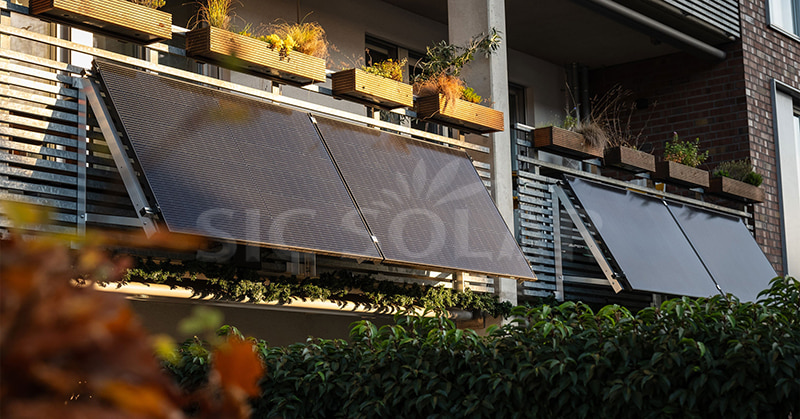
These systems offer several benefits. Vertical wall installations can reduce dust accumulation on panels and may perform well during winter months when the sun is lower in the sky. They also make efficient use of building surfaces that would otherwise remain unused.
Structural safety is one of the most important considerations for both railing and wall-mounted systems. The mounting surface must be able to handle the additional weight of the solar panels as well as wind loads and weather exposure. Proper engineering calculations are necessary to ensure long-term stability.
Material quality is equally important. Mounting components are typically made from aluminum and stainless steel to provide corrosion resistance and durability. High-quality fasteners and secure anchoring systems help maintain system reliability over time.
Manufacturers such as SIC Solar provide photovoltaic mounting solutions designed for balcony railings and wall-mounted applications. Their systems include adjustable brackets, rails, and fastening components engineered for secure installation and efficient assembly. These solutions help installers adapt solar systems to different building structures while maintaining safety and performance.
Another important factor is sunlight exposure. Wall-mounted and railing-mounted panels may not always achieve the same energy production as optimally tilted rooftop systems. The orientation of the building, shading from nearby structures, and installation angle all influence system efficiency. South-facing installations in the northern hemisphere usually provide the best results.
Maintenance access is generally convenient for these systems because they are easier to reach compared to rooftop installations. Cleaning and inspections can often be performed without specialized equipment, helping maintain energy efficiency over time.
Mounting solar panels on railings or walls offers a flexible and space-saving solution for urban solar energy generation. With proper structural support, reliable mounting systems, and careful installation planning, these systems can provide stable and effective renewable energy performance in a wide range of applications.



 IPv6 network supported
 English
  Deutsch
 español
 português
 Nederlands
 العربية
 日本語
日本語 한국의
한국의 Melayu
 Tiếng việt