
What Are You Looking For?

You choose correct mid clamps end clamps by matching frame thickness, material, load rating, and environment. Solar panel mid clamps sit between adjacent panels, while solar panel end clamps secure the first and last panel at each row edge. These small parts hold your array together, keep panel spacing even, and resist wind and snow forces. The solar mid clamp vs end clamp comparison below covers compatibility, materials, and cost so you can pick the right hardware with confidence.
Match every clamp to your panel frame thickness. A correct fit prevents loose panels, microcracks, and costly repairs.
Use the right material for your environment. Choose stainless steel 316 near saltwater and aluminum for dry inland sites.
Confirm your clamp matches the rail profile and load rating. This check keeps your array safe during wind and snow.
Count one mid clamp between neighboring panels and two end clamps per row. Add extra clamps in high-wind regions.
Choose durable clamps over cheap ones. Quality hardware protects your solar array and cuts future maintenance costs.
A solar mid clamp sits between two adjacent PV modules. It presses both module frames onto the same mounting rail and holds them firmly in place. This single piece of hardware secures the edges of two neighboring panels at once. A typical module row follows this pattern: end clamp, PV module, mid clamp, PV module, mid clamp, PV module, end clamp. You can see how solar panel mid clamps do double duty at every interior joint.
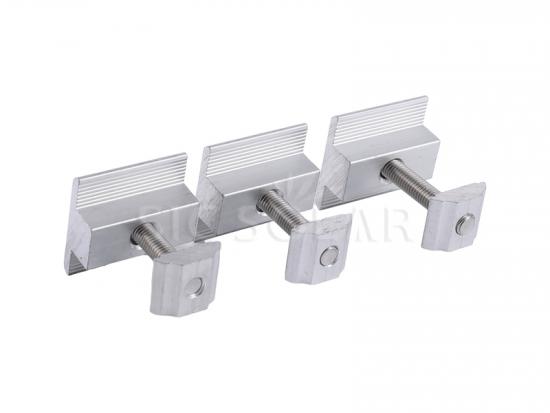
A solar panel end clamp works differently. It secures only the outermost edge of a module at the beginning and end of each row. The clamp has one ledge instead of two. It grips a single module frame and transfers wind uplift, snow load, and thermal expansion forces to the rail. This makes the end clamp critical for structural integrity because it protects the most exposed part of the row. When you compare solar mid clamp vs end clamp hardware, the difference comes down to position and the number of frames each one grips. For specific product options, see SIC SOLAR solar panel end clamps.
Proper sizing and installation keep your array stable for decades. A mid clamp also maintains a consistent gap between adjacent panels, usually around 5–20 mm, which allows for thermal expansion and contraction. The clamp spreads force evenly across both frames and reduces the risk of stress concentration. Some designs include grounding teeth that penetrate the anodized frame coating to maintain electrical continuity across the array.
Incorrect clamps cause real problems. Loose clamps lead to vibration and panel movement. That movement can cause microcracks in the solar cells. Microcracks may develop into inactive cell areas, which reduce performance and require corrective maintenance. Repair costs include module replacement, service visits, access equipment, electrical isolation, removal, reinstallation, testing, and documentation. When you choose correct mid clamps end clamps, you avoid these expenses and protect the long-term safety of your installation.
The single most important compatibility check is frame thickness. A clamp jaw that does not match the module frame height cannot seat correctly, and a loose grip invites trouble. Match the clamp size to the frame dimension before you order anything.
|
Standard panel frame thickness |
Compatible mid/end clamp size |
How it determines compatibility |
|---|---|---|
|
30 mm |
30 mm clamp |
The clamp must match the 30 mm frame thickness to fit securely. |
|
35 mm |
35 mm clamp |
The clamp is selected based on the 35 mm panel frame thickness. |
|
40 mm |
40 mm clamp |
The clamp must match the 40 mm panel frame thickness. |
In practice, a 40 mm frame uses a 40 mm clamp, a 35 mm frame uses a 35 mm clamp, and a 30 mm frame uses a 30 mm clamp. Many manufacturers design solar panel mid clamps to work with all framed modules between 30 mm and 50 mm, while solar panel end clamps typically cover 30 mm to 50 mm. Thin-film modules are the exception. Their frames are much thinner, so regular jaws cannot grip them properly. You need dedicated narrow-jaw clamps for those panels. For special module designs, thin-film solar panel mid clamps are another option to review.
A frame-height mismatch prevents the clamp from seating correctly. Under wind uplift, the clamp can fail because it never gripped the module frame in the first place. If you force the rails into alignment while tightening, the module frame carries a permanent torsional pre-load. That stress makes the glass susceptible to micro-cracking. Always verify both thickness and frame type for a secure fit.
Clamp compatibility does not stop at the frame. The clamp must also match your rail profile and mounting hole pattern. Common rail profiles include UR-40 and UR-45 Ultra Rail, and each accepts specific clamp bases. Check the manufacturer datasheet before purchase. A clamp that fits the frame but not the rail leaves you with an unreliable connection.
Improper torque creates its own problems. Overtightening can scratch, deform, or damage the aluminum frame. Too little torque lets panels shift in the wind. Mismatched or non-standard parts may also void your panel warranty and complicate future repairs. Universal clamps look convenient, but broad compatibility claims mean little without supporting datasheets or certifications. Poor-quality brackets can lead to system failure.
Before you buy, confirm three things: the frame thickness falls inside the clamp's stated range, the clamp base matches your rail profile, and the mounting holes line up with the rail slot. This quick check protects your array and keeps your warranty intact.
High-quality aluminum and stainless steel both resist corrosion and hold up for decades, but they behave differently in the field. Aluminum alloy 6061-T6 and 6063-T6 form a natural oxide layer that resists oxidation, and they weigh roughly 35% of an equivalent steel part. That lighter weight matters on rooftops with structural limits. Stainless steel 304 handles standard fasteners and clamps, while 316 adds molybdenum for exceptional resistance to chloride pitting within three miles of saltwater.
Material choice should follow your rooftop corrosion environment. Coastal, marine, and industrial sites demand stainless steel 316 or galvanic isolation through polymer washers and EPDM gaskets. Dry inland sites often work fine with anodized aluminum. Protective coatings such as anodizing, powder coating, and galvanization add another barrier against rust, UV degradation, and chemical exposure.
|
Material |
Best-Fit Environment |
Key Strength |
|---|---|---|
|
Aluminum 6061-T6 / 6063-T6 |
Dry, arid regions |
Lightweight, self-repairing oxide layer |
|
Stainless steel 304 |
Standard inland installations |
Corrosion resistance, high-temperature tolerance |
|
Stainless steel 316 |
Coastal and marine sites |
Chloride pitting resistance |
Wind and snow loads directly affect clamping strength and the number of clamps you need. In high-wind or heavy-snow areas, engineers add extra solar panel mid clamps and solar panel end clamps to withstand the forces acting on the array. A row of five panels needs four mid clamps and two end clamps; a row of ten needs nine mid clamps and two end clamps. Multiply those counts by the number of rows.
SIC SOLAR states that in areas with high wind speeds or heavy snow accumulation, additional clamps may be required, and engineering calculations determine the exact number needed.
SIC SOLAR mounting systems comply with AS/NZS 1170 and JIS C 8955:2011, with tested ratings up to 60 m/s wind speed and 1.4 kN/m² snow load. The company backs its products with a 10-year warranty and a 25-year lifetime. When you weigh solar mid clamp vs end clamp options, confirm the load rating matches your site before you order. You can also compare specifications on the SIC SOLAR quick-mount mid/end clamp product page.
Your local climate should drive your clamp material choice. Coastal zones combine salt spray, high humidity, and wind fatigue. In these areas, use SUS316 stainless steel fasteners within 500 meters of the coast. Saltwater infiltrates the interface between SUS304 and aluminum over years, so upgrading to stainless steel 316 fasteners resists chloride pitting and supports long-term performance.
Desert environments create a different threat. Sand abrasion and intense UV radiation degrade ordinary coatings. SUS316 works well for salty desert zones such as the Atacama or Arabian coast. Anodized aluminum Class 25 suits coastal desert conditions like the Arabian Gulf, where salt and UV attack occur together. Snowy climates require reinforced materials such as stainless steel and galvanized steel to support additional snow weight without deforming. Before you select solar panel end clamps for a cold region, verify that the system's span tables match your local snow load zone.
Adjustable clamps earn their higher price in specific situations. They adapt to varying panel frame thicknesses from 30 mm to 40 mm, plus custom sizes. This flexibility helps when a project uses panels with different frame depths, or when you mount on uneven or sloped rooftops. They also let you fine-tune tilt angles for better solar energy capture.
Still, adjustable systems cost more upfront. Tilting panels away from parallel doubles the aluminum required and increases wind uplift, which may force you to reinforce rafters. You might spend the extra money on an additional solar panel instead. Run reliable modeling before you decide.
Balance upfront price against long-term value. Inexpensive clamps can damage panels and void warranties, leading to replacement costs that exceed any savings. When weighing solar mid clamp vs end clamp options, verify the manufacturer's datasheet for frame thickness, rail profile, and load rating. SIC SOLAR designs simple, durable, and economical mounting systems that save labor costs while complying with AS/NZS 1170 and JIS C 8955:2011. Professional installation prevents roof leaks and panel damage.
You now know the four factors that matter most when you choose correct mid clamps end clamps: compatibility, material and load capacity, environment, and adjustability versus cost. High-quality solar panel mid clamps and solar panel end clamps prevent panel damage, reduce maintenance, and ensure long-term safety. Always verify manufacturer specifications before you buy. Check frame size, follow torque guidelines, and confirm load ratings for your region.
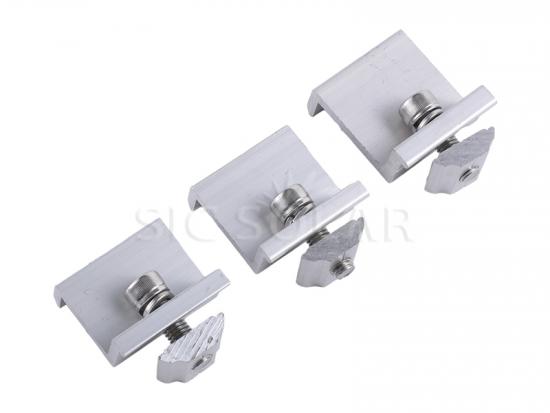
Each mid clamp and end clamp comes equipped with a socket head screw, a sliding nut, and a spring washer. Place the panel flat on the rail, slide the end clamp kit (MA) into position, ensuring it firmly sticks to the solar panel, and then tightly lock the bolt (recommended torque: 8 N·m).
Prioritize durability over the lowest price. This choice protects your array for decades.
These answers address the most common clamp selection questions from solar installers and DIY homeowners.
Check your module datasheet for the frame thickness. A 40 mm frame requires a 40 mm clamp. A 35 mm frame requires a 35 mm clamp. Then verify the clamp base matches your rail profile. Choose correct mid clamps end clamps based on these two measurements.
A five-panel row needs four solar panel mid clamps and two solar panel end clamps. A ten-panel row needs nine mid clamps and two end clamps. Multiply these counts by your total rows. High-wind regions require additional clamps per engineering calculations.
Follow the manufacturer's recommended setting. SIC SOLAR specifies 8 N·m for its end clamp kits. Overtightening can deform aluminum frames. Under-tightening lets panels shift in the wind. Check your specific clamp datasheet for the value.
Dry inland areas suit anodized aluminum. Coastal zones demand stainless steel 316. Compare the solar mid clamp vs end clamp options. Match the material to your local environment. SUS316 fasteners resist chloride pitting near saltwater.



 IPv6 network supported
 English
  Deutsch
 español
 português
 Nederlands
 العربية
 日本語
日本語 한국의
한국의 Melayu
 Tiếng việt